
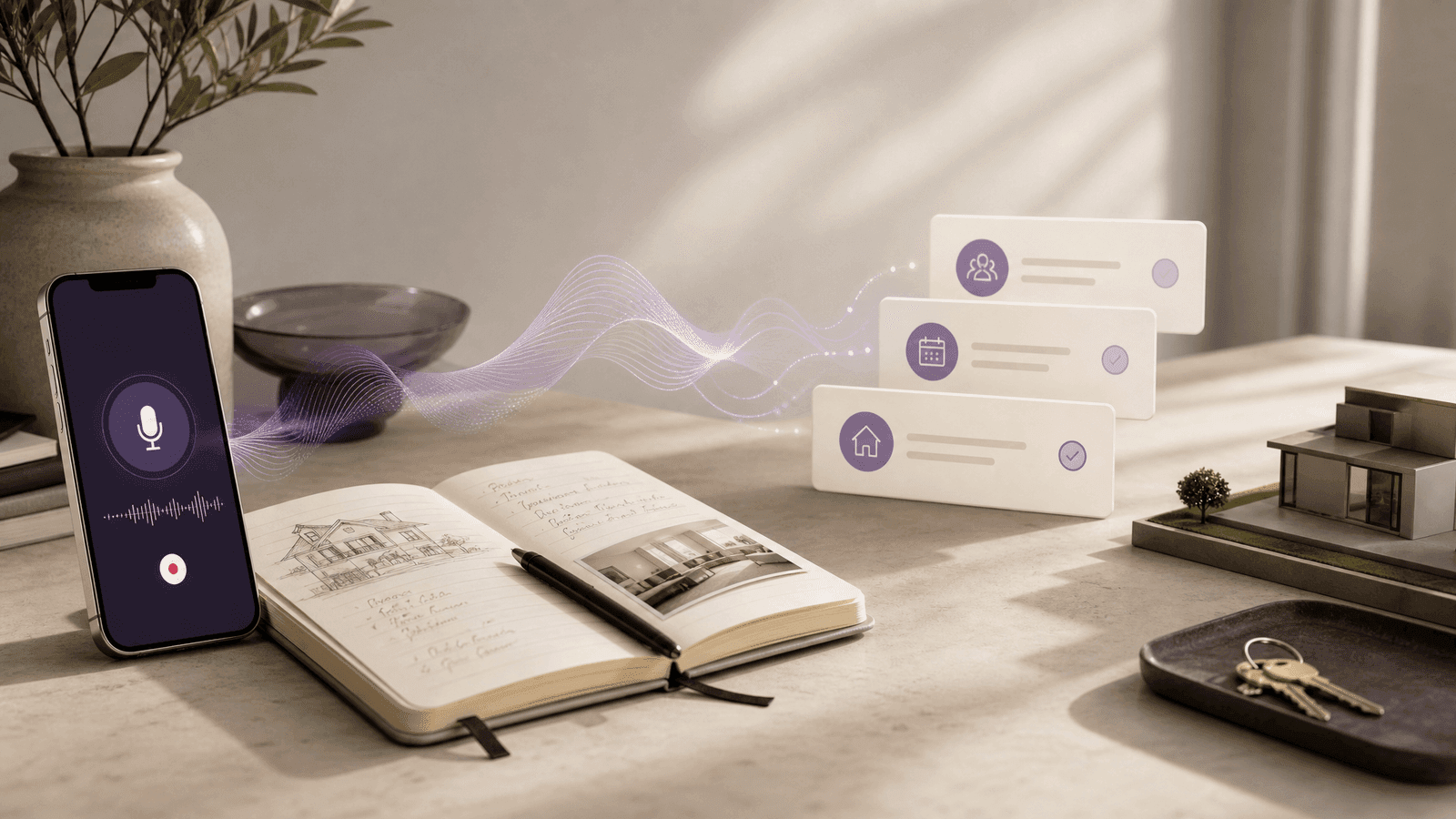
AI note-taking for real estate agents only matters if it leads to action.
That is the real standard.
A tool that records your thoughts but never turns them into a useful next step is not saving you time. It is just giving you another pile of information to clean up later.
The best use of AI note-taking in real estate is simple: capture what happened while it is fresh, organize it fast, and turn it into a follow-up you can trust.
The practical test
The useful test for voice-note follow-up is not whether the idea sounds good when you are calm. It is whether it survives a Tuesday when you have calls to return, a showing running late, a buyer asking for context, and three small follow-up promises competing for space in your head. That is where most CRM advice breaks down. It assumes the agent has unlimited attention for administration. Real agents do not.
So the question is simple: does the system reduce the number of things you have to remember manually? If it does, it earns its place. If it only gives you a prettier place to forget things, it is not a system yet. The entire point is to catch the gap between remembering what a client said and actually getting that memory into the CRM before it turns into a missed opportunity.
A simple workflow to copy
Start with one repeatable loop instead of trying to redesign your whole business at once. For this article, the loop is: record the voice note immediately, let Myra turn it into structured context, and attach the next follow-up while the conversation is still fresh. Write that down as the minimum viable workflow. Then run it with five real contacts before you touch the rest of your database.
The five-contact test keeps the work honest. Pick one active buyer, one active seller, one warm lead, one past client, and one long-term sphere contact. If the workflow handles those five records clearly, you can scale it. If it feels confusing with five records, it will get worse with five hundred.
When a system works, you should be able to answer three questions quickly: what happened last, what needs to happen next, and when should I see this person again? If you cannot answer those without digging, the CRM is storing information but not creating clarity.
What this looks like in Client Keeper
Client Keeper is built around the idea that a solo agent should not need a team operations manual to stay consistent. The goal is not to turn every relationship into a complex campaign. The goal is to make the next right action visible enough that you actually do it.
That is where Myra matters. Instead of waiting until the end of the day to type everything from memory, you can capture context while it is still fresh and turn it into a note, task, or reminder. The product is not trying to replace your judgment. It is trying to protect the details your future self will need when the week gets noisy.
The same principle applies whether you are migrating CRMs, comparing tools, building a follow-up cadence, or trying to remember birthdays and housiversaries. A good CRM should make your relationship work easier to maintain. It should not make you feel like you took on another part-time admin job.
Mistakes to avoid
The most common mistakes are usually small enough to seem harmless at first:
- recording audio and never reviewing it
- capturing vague notes with no next action
- waiting until evening to reconstruct the showing
- using AI notes without checking names, dates, and intent
None of those mistakes means the strategy is bad. They usually mean the workflow is too vague. Tighten the workflow before you blame yourself for not being consistent.
How to know it is working
You know voice-note follow-up is working when you stop relying on heroic memory. The proof is not that your CRM has more fields filled out. The proof is that fewer people slip through the cracks, fewer promises live only in your head, and more follow-ups happen while they still feel timely.
A good system should feel almost boring after a few weeks. You open it, see what matters, update what changed, and move on. That is the quiet win. The CRM becomes less of a project and more of a daily operating rhythm. For most solo agents, that is the difference between buying software and actually getting leverage from it.
The weekly review that keeps this from getting stale
Set one recurring appointment with yourself each week to review the system. Keep it short. Fifteen minutes is enough if the work is focused. Look for overdue follow-ups, contacts without a next step, recent conversations that never became notes, and dates that should trigger a personal touch.
This review is not about building a perfect database. It is about restoring trust. A CRM becomes useful when you believe that important relationships will surface at the right time. If you stop believing that, you will drift back to memory, sticky notes, and whatever text thread happens to be at the top of your phone.
The review should end with a small number of actions. Move the reminders that are still relevant. Delete or archive what is noise. Add context where the record is too thin. Then close the system and go back to selling. The whole point of a simple CRM is that it gives you leverage without turning the administrative layer into the main event.
If you are not sure whether the system is working, ask one question at the end of each week: did it help me remember someone I might have otherwise missed? If the answer is yes, keep tightening. If the answer is no, simplify until it does.
Why this matters so much for agents
Real estate work happens on the move.
You are leaving showings, jumping into calls, driving between appointments, texting leads, and trying to remember ten different details from five different conversations.
That creates a very common problem:
You learn the most useful details during the day, but you do not get them into your CRM until much later — if you get them in at all.
By the time you sit down at night, the details get fuzzy.
You remember the broad strokes, but you lose the important parts: - what they actually liked - what made them hesitate - who else is involved in the decision - what to send next - when you promised to follow up
That is where AI note-taking becomes useful.
What good AI note-taking should actually do
A lot of people hear “AI notes” and imagine a magic summary.
That is not enough.
For an agent, useful AI note-taking should do three things:
1. Capture context while it is fresh The note should happen right after the call, showing, consult, or meeting.
2. Turn messy language into clean CRM details Not just a transcript. A structured record.
3. Create a next step If nothing turns into a reminder, task, or follow-up, the note did not finish the job.
That is the difference between an AI toy and an actually helpful workflow.
A realistic example
Let’s say you leave a showing and record a quick voice note:
“They liked the kitchen and backyard, but they thought the bedrooms were smaller than expected. Budget is still around 425. They want to see Maple Ridge next week. Husband is worried about commute time. Follow up Saturday morning.”
A useful AI note-taking workflow should turn that into something like this: - Contact updated: Johnson family - Showing feedback: loved kitchen and backyard, bedrooms felt small - Budget: around 425 - Objection: commute concern - Next property to discuss: Maple Ridge - Follow-up: Saturday morning
That is useful.
That can move a relationship forward.
Why typing notes later usually fails
The old workflow sounds fine in theory.
“After I get home, I’ll update the CRM.”
But in practice, that usually means one of three things: - you forget half the details - you only write a vague summary - you put it off entirely
The result is a CRM full of weak notes like: - nice couple - wants 4 bed - follow up next week
That is not enough.
Strong follow-up depends on specifics.
The details are what make your outreach feel personal and useful instead of generic.
Where this fits into Client Keeper and Myra
This is exactly where a tool like Myra can become meaningful.
The strongest use case is not “AI for the sake of AI.” It is reducing the admin burden that makes agents avoid their CRM in the first place.
A voice-friendly workflow is powerful because it lets the agent: - speak naturally - capture details in the moment - avoid late-night data entry - turn notes into usable follow-up actions
That is a much more compelling story than generic “AI-powered CRM” messaging.
Best moments to use AI note-taking in real estate
After a showing This is the most obvious use case.
What to capture: - what they liked - what they disliked - budget reactions - timeline changes - what property to show next
After a listing consult Capture: - objections - seller concerns - timing - motivation - pricing expectations
After an open house conversation Capture: - who they are - whether they are already working with an agent - timeline - financing status - what they asked for next
After a phone call with a lead Capture: - how serious they are - what they are actually looking for - what to send them - when to re-engage
How to make AI notes actually useful
If you want this to work in real life, use a consistent structure.
A simple voice-note prompt might be: - who this is - what happened - what mattered most - what they want next - when I need to follow up
That keeps your notes practical instead of rambling.
Common mistake: collecting notes instead of building follow-up
This is the biggest trap.
Some agents end up with better summaries but still no reliable next-step system.
That means the tool improved storage, but not execution.
The note should lead to one or more of these: - a task - a reminder - a contact update - a property preference update - a scheduled follow-up
If it does not do that, you are still one step short.
What makes this a good SEO and AEO topic
This topic works well because it answers a specific behavior question agents actually have.
It is not broad fluff. It is not generic “AI in real estate.”
It is highly searchable and highly citable because it is practical.
It also gives Client Keeper a much more ownable story than trying to sound like every other CRM talking about automation.
Final takeaway
AI note-taking is not valuable because it writes pretty summaries.
It is valuable because it helps real estate agents remember the details that matter and follow up faster without more typing, more admin, or more end-of-day cleanup.
If the note stays a note, it is only half useful. If it becomes the next action, that is when it starts helping your business.
Why this matters
Speed and specificity compound. MIT and InsideSales research is commonly summarized as showing that leads contacted within five minutes are 21 times more likely to qualify than leads contacted after 30 minutes.
NAR's 2025 Profile also reported that 88% of buyers purchased through an agent and 91% of sellers used an agent, which is a reminder that the relationship layer is still where trust is won.
Frequently asked questions
Is AI note-taking the same as a CRM update?
No. AI note-taking is only helpful if it leads to an organized CRM update, reminder, or next action.
When should real estate agents record voice notes?
Right after showings, calls, listing appointments, or open-house conversations — while the details are still fresh.
What details are most important to capture?
What the client liked, what worried them, their timeline, their budget, and what the next step should be.
Why is voice better than typing for many agents?
Because it is faster in the moment, especially between appointments, and it reduces the chance that details get forgotten later.
What should I say in a real estate voice note?
Say the client name, property or topic, what they cared about, what changed, and the next follow-up. A useful voice note is less like a diary entry and more like a short handoff to your future self.
Keep reading

Author
Phillip Shepard
Founder of Client Keeper / Licensed Realtor #89829 / Collier and Associates
Phillip Shepard is the founder of Client Keeper and a licensed Realtor (#89829) with Collier and Associates in Bentonville, Arkansas. He writes about practical CRM systems for agents who need follow-up to become easier, not louder.